Collectively forming Rise Together
In response to surging rents, growing inequities, and displacement due to the tech boom of the 2010s, six community-based nonprofit organizations rallied together to combat the region’s affordability crisis. In 2017, the Rise Together collaboration campaign was formed to raise $25 million to help those left behind by the region’s rapid growth.
Africatown Community Land Trust, Byrd Barr Place, Community Roots Housing, GenPride, Southwest Youth & Family Services, and White Center Community Development Association came together in recognition that some communities faced more pressures from growth than others.
In 2017, these groups joined forces to create new community-driven, place-based programs and services alongside desperately needed affordable housing options. The six partner organizations worked to strengthen the communities they serve through collaborative investment in their neighborhoods and in each other.
Each of the organizations brought a variety of tools, expertise, and connections that increased their ability to fight displacement and increase opportunities in White Center, and Seattle’s Central District and Capitol Hill neighborhoods.
Two years of strategic planning
Rise Together grew out of conversations about displaced Black residents in the Central District, LGBTQ+ seniors priced out of Capitol Hill, and multigenerational families struggling to make ends meet in Seattle and White Center. The fundraising campaign focused on six projects, which resulted in over 400 new affordable homes alongside space for human services, health care, community, and affordable retail for local businesses.
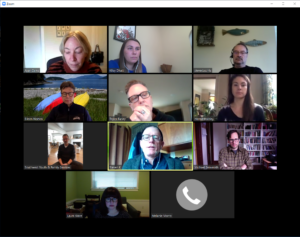
A collaborative fundraising tactic like this was unusual. The nonprofits couldn’t find other models of this work, so they formed their own. The
organizations formed a Capital Campaign Steering Committee which had representation from each nonprofit. The leaders strategized with consultants and conducted feasibility studies to help inform their approach.
A funding model rooted in collaboration instead of competition
After years of planning, the collaborative shared staff and resources, and pooled the capital rather than competing. Each organization had to build up either its operational or financial capacity to meet the demands of longevity and complexity of the campaign and its six projects. This caught the eye of high-profile donors such as the Bill & Melinda Gates Foundation.
Former Rise Together Campaign Manager, now VP of Philanthropy and External Relations, Kiley Dhatt, shared, “Rise Together really starts with affordable housing. Then asks, what else does community really need to thrive?” The campaign focused on how rapid growth left behind people of color, refugees, LGBTQ+, seniors, artists, and low-income families.
Community-driven equitable development projects
The Rise Together collaborative focused on six community-driven equitable development projects in the Central District, Capitol Hill and White Center.
Central District
The Central District neighborhood has been the center of African American and Africa diaspora life in Seattle for over 130 years. In the 1970’s, the Central District was nearly 80% Black; now that figure is less than 20%. Redlining, disinvestment, and racist housing policies displaced families and those with the lowest incomes.
Rise Together focused on the Central District due to this potent legacy of racial exclusion and the neighborhood’s high need for affordable housing, commercial affordability, economic development, and cultural preservation.
Liberty Bank Building, opened 2019
Partners: Africatown Community Land Trust, Black Community Impact Alliance, Byrd Barr Place, and Community Roots Housing
The first project in the Rise Together pipeline to be completed was Liberty Bank Building. Located on the site of the first Black-owned bank in the Pacific Northwest, the six-story building holds 115 affordable homes and space for local, Black-owned businesses. It carries reminders of the institution that once stood there. It stands as a living monument to the history and future of Seattle’s pan-African community.
In 2019, Liberty Bank Building opened its doors to residents, and the first lease-up used affirmative marketing strategies to reach Black residents. That included people displaced or at risk of displacement in the neighborhood. At initial lease-up, 86% of residents were African American.
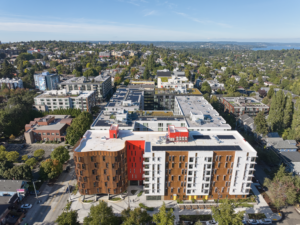
Africatown Plaza, opened 2023
Partners: Africatown Community Land Trust, Community Roots Housing
Down the street from Liberty Bank Building is Africatown Plaza, which added 126 affordable homes to the neighborhood.
The project broke historic barriers and paved the way for Black-owned MAD Construction to be the general contractor for the development through a joint venture with Absher Construction. Over 50% of the project’s subcontracts were given to Black-owned Businesses.
Africatown Plaza wasn’t in the original Rise Together plan. But with the support of the King County Office of Housing, Homelessness, and Community Development in 2019, $2 million was awarded to the project. Another $12 million was awarded to the Africatown Community Land Trust by the City of Seattle Office of Housing. As plans for the project progressed, the Rise Together partners agreed it made sense to add it to the capital campaign to support buildout of Africatown Community Land Trust’s new headquarters on the ground floor.
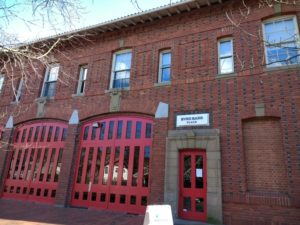
Byrd Barr Place Fire Station 23, completed 2022
Partners: Byrd Barr Place, Community Roots Housing
Byrd Barr Place was founded in 1964 and initially launched as a grassroots activist organization. The organization was leasing the 110-year-old Fire Station 23 from the City of Seattle and requested ownership rights in 2010. This began a decade-long process of transferring ownership of the building to Byrd Barr Place.
Byrd Barr Place provides anti-poverty programs and services, including energy assistance, housing assistance, a food bank and home delivery nutrition program, personal finance education and more.
By undertaking ownership and renovation including critical seismic and safety upgrades in 2022, Byrd Barr Place ensured that the historic Firehouse continues to be an anchor for the community for decades to come.
Capitol Hill
The Capitol Hill neighborhood is the historic home and cultural center for LGBTQIA+ life in Seattle. LGBTQ+ seniors face a unique set of challenges: they are more likely to be in poverty, isolated from family, and face health disparities. Capitol Hill has suffered from astronomical rents and a lack of family-sized housing, which displaced communities out of their neighborhoods.
Rise Together focused on building in Capitol Hill due to rapid rising costs of rental homes and the displacement of LGBTQ+ seniors and low-income families.
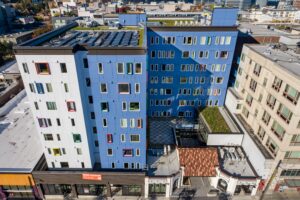
Pride Place, opened 2023
Partners: GenPride and Community Roots Housing
Located on Broadway between Pike and Pine, Pride Place is an eight-story building which has 118 affordable apartments above an LGBTQIA-focused community and health services center run by GenPride.
It opened in October 2023, and it was purposefully designed to provide safe, affordable, stable housing for LGBTQIA+ elders and allies ages 55+ to age in community. The building creates a welcoming space for people to come together for meals, board games, or simple conversation.
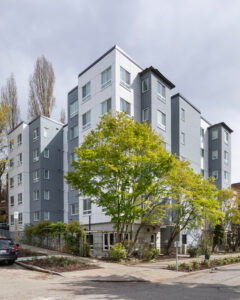
Boylston-Howell Family Housing, completed 2023
Boylston-Howell Family Housing was an existing building in Community Roots’ portfolio, including 20 affordable two- and three-bedroom family sized units for those with the lowest of incomes.
At the time of rehabilitation, families who needed large three-bedroom apartments had to pay on average $3,450 per month. The renovation of the Boylston-Howell F aimed to close that affordability gap and keep families rooted in their homes.
The Rise Together campaign made a comprehensive rehabilitation of this building possible.
White Center
White Center is an urban, unincorporated area just south of Seattle city limits. It has a large immigrant and refugee population.
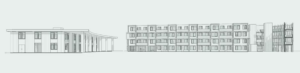
White Center HUB & Canopy White Center, opened 2026
Partners: White Center Community Development Association (CDA), Southwest Youth & Family Services, and Community Roots Housing
Nearly 10 years in the making, the White Center HUB project created a family resource center and affordable housing complex to help anchor and meet the needs of the White Center community. Canopy White Center provides 76 new, affordable homes to the neighborhood, while the White Center HUB brings community space, resources, and health and social services together under one roof.
The campus is home to the White Center CDA, Southwest Youth and Family Services, HealthPoint, FEEST, and the YES! Foundation. The brand new space helps these organizations expand their programming through an onsite medical and dental clinic, a coffee shop, recording studio, event hall, future commercial kitchen, maker space, playground, and gathering areas designed to bring people together.
White Center CDA Executive Director, Aaron Garcia, said “Our vision for equitable development is grounded in the principles of community stewardship of land which transforms land into a shared resource that generates community prosperity. Land is a resource to be shared and cared for, used to heal and transform the legacies and ongoing impacts of colonization, genocide, and racism.”
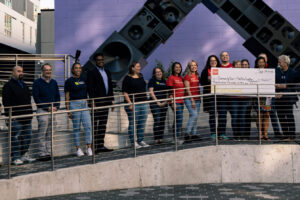
Six nonprofits framed a development model for future generations
Each nonprofit brought their own unique skills, resources, and relationships to the table. They learned early on that transparency with one another paid dividends. Equity was at the center of every conversation, and the nonprofits had to change their policies throughout the campaign to be more flexible. Rise Together required a high degree of trust between the stakeholders, funders, developers, partners, and the communities.
Founded in 1976 as a Public Development Authority, we have been building a more affordable Seattle in partnership with the residents and communities we serve. Rise Together was a continuation of that work. It continues to shape Community Roots’ approach to building and preserving affordable housing for 50 more years to come.