For 50 years, Community Roots Housing has worked to create and preserve affordable homes across Seattle and White Center. What began as a neighborhood response to redlining and disinvestment has grown into a long-term commitment to housing stability, community resilience, and equitable development. Throughout the decades, the organization continues to use every available tool to create and preserve homes for people who need them most.
The Larned Apartments and Byron Wetmore Apartments are two early examples of that adaptation. Together, they demonstrate a refusal to give up supporting Seattle’s low-income residents.
Seattle’s cycles of boom and bust have brought both opportunities and challenges, often determining who can remain in the city as rents rise, buildings change ownership, and public priorities shift.
The late 1980s and early 1990s were one of those periods.
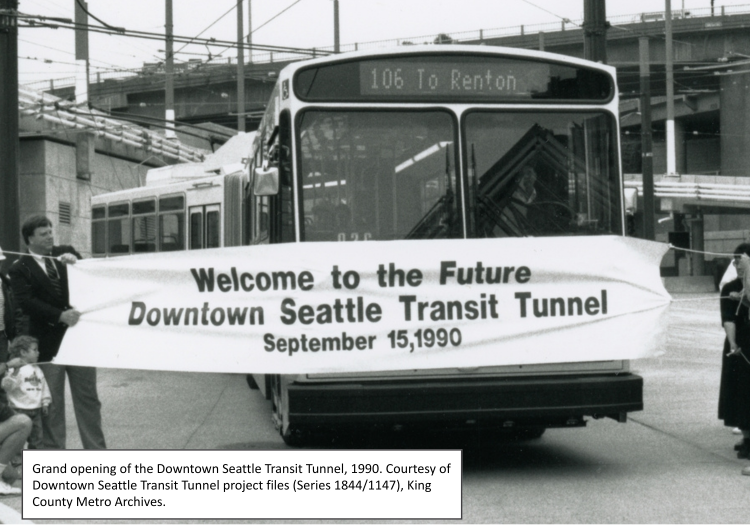
At that time, Seattle was recovering and re-growing from the Boeing bust. With 516,000 residents in 1990 compared to over 780,000 in 2026, downtown was undergoing large redevelopment projects. The Columbia Tower, Westlake Mall, Downtown Seattle Transit Tunnel, and the Washington State Convention Center all reflected a major push to remake the city’s urban core. These projects represented investment and growth, while also raising difficult questions about who benefited from redevelopment and who was displaced by it.
Even then, the pressures that define today’s housing crisis were evident.
When Reaganomics put renters at risk
 During the Reagan administration (1981-1989), federal support for public housing and the social safety net was eroding. Direct federal support for public housing declined, and national policy increasingly shifted toward vouchers and private-market tax incentives.
Cuts to safety net programs strained low-income residents. Reductions in unemployment insurance, food assistance, welfare, and disability benefits made it more difficult to afford rent, groceries, and basic needs. For people already living on the edge, a small loss of income could trigger homelessness.
Locally, Washington State and Seattle began developing responses to this disinvestment. There was growing recognition that local and state governments would need to play a larger role to preserve and create affordable homes.
What Seattle was losing: affordable housing
To understand why this period mattered, it is important to understand what was disappearing.
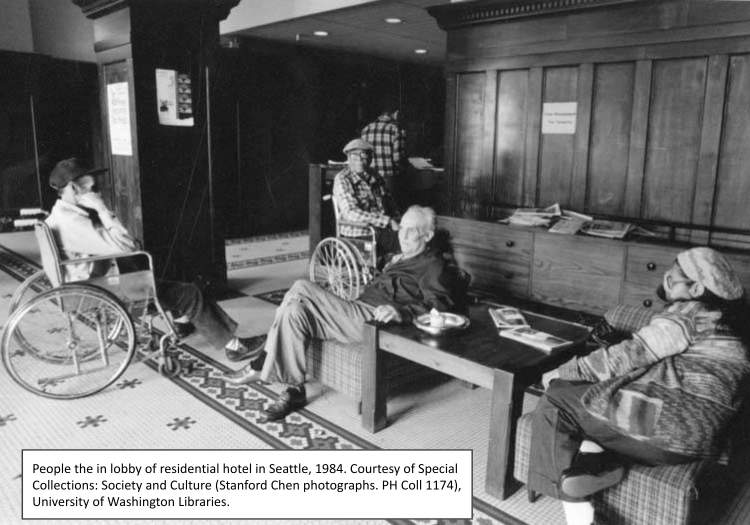
Until the mid-1990s, many of Seattle’s lowest-income renters relied on older low-cost housing. This included residential hotels and boarding houses (also known as single room occupancy housing or SROs), and older apartment buildings. While not glamorous, these properties served as naturally occurring affordable housing (NOAH), offering small, inexpensive units without government subsidies to those unable to afford the average cost of rent.
Housing costs were increasing faster than incomes
Rents increased by 82 percent between 1980 and 1990. In 1992, a full-time worker earning minimum wage would have made $4.25/hour or roughly $736 a month. Yet that same year, the average monthly rent in the city was $521 — over 70% of a minimum wage worker’s earnings.
At the same time, Seattle was losing the housing that had historically served people with the lowest incomes. Through the 1970s and 1980s, SROs steadily disappeared downtown, and many older apartment buildings were condemned or left vacant.
The loss of thousands of affordable units downtown led to increased homelessness. By 1990, an estimated 3,000 people were unsheltered in Seattle. The city faced not just a housing shortage, but the consequences of losing a fragile yet essential safety net.
As the crisis deepened, people organized
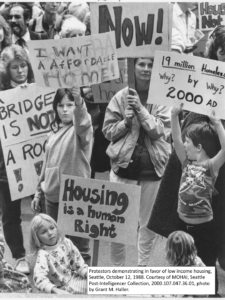
Activists, social service providers, religious leaders, and residents responded to the loss of affordable housing and the visible rise in homelessness.
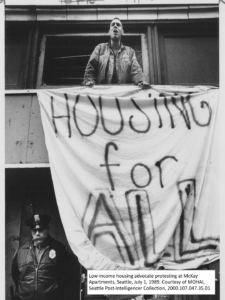
Groups like Operation Homestead brought direct action into the center of the debate. Through building occupations and public protest, activists demanded that vacant or underused buildings remain low-rent housing and be used as emergency shelters. Their actions were direct, disruptive, and clear: empty buildings should not sit unused while people had nowhere to live.
In the late 1980s and early 1990s, activists occupied buildings such as the McKay Apartments, Arion Court, the Pacific Hotel, and the Gatewood Hotel. One precedent-setting fight was over the McKay Apartments at Seventh Avenue and Pike Street. In 1987, the Washington State Convention Center board closed the 73-unit building for redevelopment. Operation Homestead fought for years to reopen the building after occupying it in 1989. Their campaign helped pass Washington State House Bill 2988 in 1990, which raised an additional $800,000 in public funds to replace the affordable rental homes lost to Convention Center development.
Tensions resurfaced on September 29, 1992, when police arrested 26 demonstrators and cleared about 200 homeless individuals occupying the vacant Pacific Hotel in protest of SRO losses and insufficient emergency shelter. On the same day, another former downtown hotel was being reopened as affordable housing.
The Larned Apartments: From boarded-up hotel to affordable homes
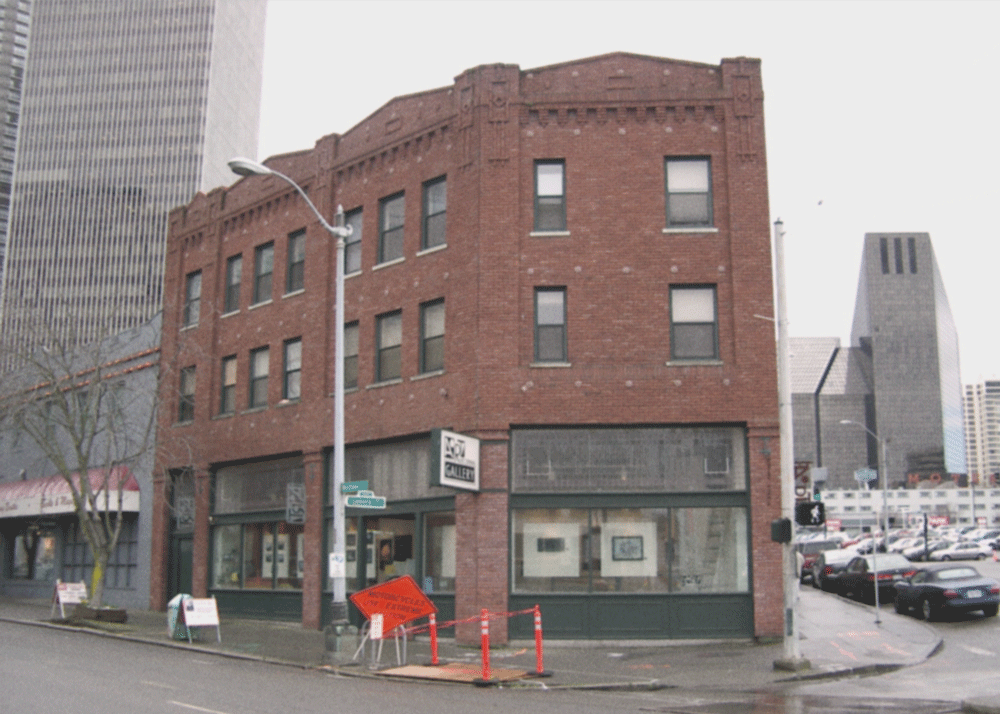
On September 29, 1992, one mile north of the Pacific Hotel, Community Roots, then known as Capitol Hill Housing Improvement Program, celebrated the grand opening of the newly renovated Larned Apartments in Belltown.
Built in 1909 as a residential hotel, the Larned had been boarded up since 1984. Rather than remain vacant and deteriorate, it was renovated into 33 affordable homes: 29 studios and four one-bedroom apartments for people with very low incomes.
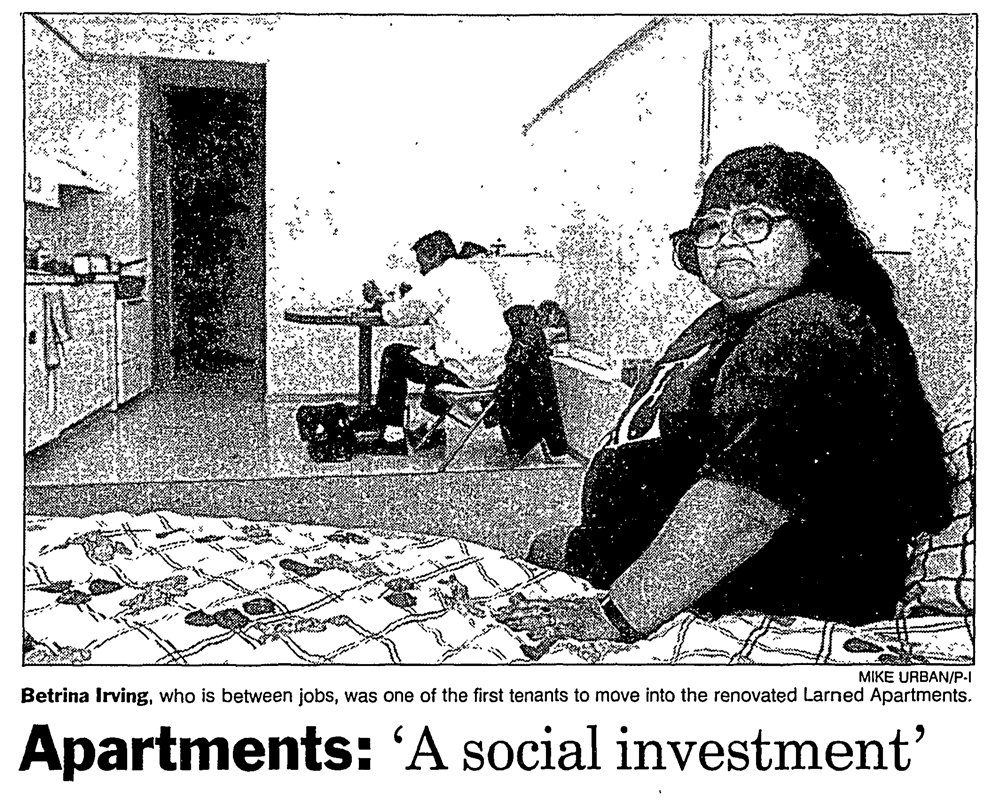
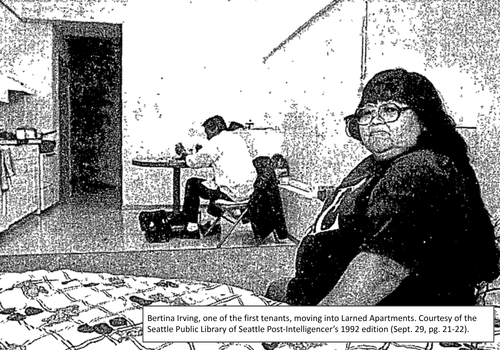
After eight months on a waiting list, Betrina became one of the first to move into the renovated Larned Apartments. She had lived in Seattle for 31 years and had watched old downtown hotels and apartment buildings get swallowed up by the new high-rise skyline. When she was working, Irving earned $5.50 an hour in light manufacturing assembly. She was between jobs when moving into the Larned and living on $322 a month in public assistance. A few months earlier, she had been paying $400 a month for an old apartment in the Denny Regrade.
Her new studio rented for $175 a month.
The residents moving into the Larned reflected the workers and neighbors most affected by Seattle’s housing pressures. The building served people earning between $4.50 and $7.50 an hour, including fast food workers, retail clerks, taxicab drivers, janitors, and others in low-wage jobs. It also served people receiving Social Security benefits. Most monthly rents ranged from $175 to $210.
By converting a vacant hotel into 33 affordable homes, the project addressed abandoned downtown buildings and provided stable housing for those most at risk of displacement.
LIHTC: A new tool for affordable housing
The Larned celebration was not only a grand opening. It was also a signal that affordable housing finance was beginning to change.
The Larned was one of Seattle’s first renovation projects to use Low-Income Housing Tax Credit (LIHTC) funding. Established by the Tax Reform Act of 1986, LIHTC shifted affordable housing finance from direct federal subsidies and public loans to a model where private investors provide equity in exchange for federal tax credits.
The Larned renovation cost $2.7 million, and its funding reflected the increasingly layered structure of affordable housing finance.
The project included $947,000 from the City of Seattle, $350,000 from the Washington State Housing Assistance Program, about $980,000 in tax credit investment, and $300,000 from the Washington State Convention and Trade Center. That final source was especially significant: it came from affordable housing funds secured after housing activists occupied the McKay Apartments and pressured public officials to replace homes lost to Convention Center development.
This kind of financing represented a new era.
While LIHTC helped create vital homes, it did not fully replace the deeply affordable public housing and residential hotels being lost. LIHTC housing generally serves low-income households between 30% and 60% of area median income.
Affordable housing development would increasingly depend on assembling multiple sources of funding: city dollars, state dollars, mitigation funds, bank financing, investor equity, and federal tax credits. LIHTC was a new tool for organizations like Community Roots to build more affordable housing.
The Byron Wetmore Apartments: Using LIHTC to build what Seattle families needed
One year later, that new tool helped make another Community Roots milestone possible.
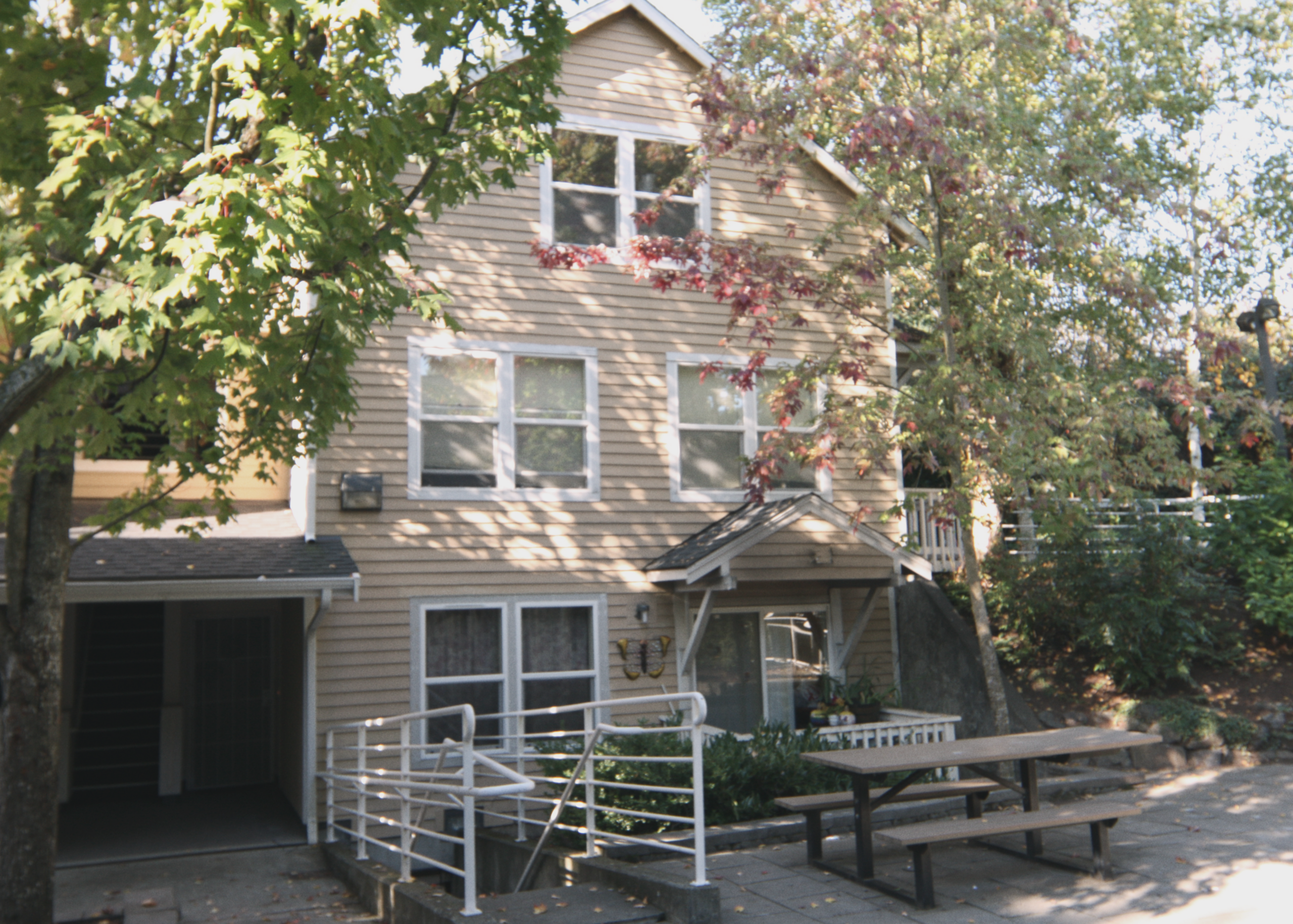
In 1993, the same LIHTC funding announced at the Larned was used to build the Byron Wetmore Apartments in the Mount Baker neighborhood. Located two blocks south of Franklin High School, the project was built on a site that had been vacant since 1936. It was described as the first new multifamily housing in Rainier Valley in many years.
Byron Wetmore created 12 deeply affordable, family-sized homes at a time when much of the housing preserved downtown consisted of studios and one-bedrooms. The project showed that Community Roots could create housing that the market was not providing.
The $1.1 million project used financing from Seafirst Bank and LIHTC equity, which pooled contributions from Boeing and Washington Mutual. Public funding came from the City of Seattle and the Washington State Housing Assistance Program. The project was built in partnership with Southeast Effective Development (SEED).
For Community Roots, this marked an important shift. Like Larned, Byron Wetmore reflected the emerging complexity of affordable housing development while naturally occurring affordable housing was dwindling.
What history teaches us
Seattle’s housing challenges neither began in the 1980s nor ended in the 1990s. The city continues to experience cycles of growth, displacement, and scarcity, raising the ongoing question: who belongs in Seattle?
The Larned and Byron Wetmore offer one answer. The lesson from the past 50 years has been to adapt without losing sight of our mission: everyone deserves a quality, affordable home. This mission is made possible when people organize, advocate, invest, preserve, and build. Community Roots’ history is shaped by residents and communities who refused to give up the places they called home.